

Onward Only Christian Soldiers?
By Chuck Fager
What was the recent kerfuffle over military chaplains about?
What does it mean? The answers may not be what you think.
[Reconnaissance is adapted & restacked from the Quaker House Substack. Quaker House is reader-supported. To receive new posts and support its work, go to quakerhouse.org ]
On December 16, 2025, SecDef Pete Hegseth announced he was banning the official U. S. Army Spiritual Fitness Guide, written by an interfaith group of military chaplains, which had only been released in August, four months earlier. When published, the slim book was hailed by the chiefs of the Army Chaplain Corps as “a historic milestone” to prepare troops for “success in war and life.”
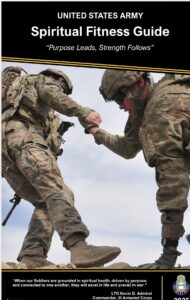
But Hegseth denounced the Guide as infected with “secular humanism,” contaminated with “New Age” notions, and deformed by “political correctness.”
Overnight, the Guide, and an associated “Battle Book”— both of which were online in unclassified files — disappeared from government websites.
Numerous links from news articles about their August release now went straight to “404-Nothing-to-See-Here” error messages.
Hegseth vowed that the Guide would soon be replaced by unspecified new programs to “make the chaplains corps great again.”
Of course, this banishment only made some potential readers more curious. (That would include me.)
What in the world could the Guide’s 120 pages contain that was so subversive or offensive to warrant such an instant purge? Maybe he was exaggerating or fabulizing?
How could I find out, and cite it accurately if it had been disappeared like an ICE detainee in El Salvador’s CODEC dungeon?

Well, this old investigative reporter has “intel” sources and methods too. And soon a source stepped up, one with the right method. A copy of the verboten Guide was located which had eluded the shredder. [Readers who are equally curious can examine it here]
Was it really promoting what Hegseth disdained in his announcement as “secular humanism”? Was it a part of what he believes (and wrote an entire book denouncing as) the “war on warriors?”
In that tome, Hegseth declared in the opening pages, “Make no mistake about it: the Left wants to destroy the one institution standing between them and total control-the United States military. … In The War on Warriors, I describe how we got here, what the threat is … and how we can take back the high ground to save our military. … If we lose our military, the world’s last best hope is toast. And then freedom is toast—because that military, eventually, will be turned on us.”
And clearly, as he turned the pages of the new Guide last summer, Hegseth thought he detected a toaster glowing red: he saw secular humanism, “New Age notions,” and chaplains coerced into being namby-pamby “emotional” counselors. Clearly, he decided, this was meant to undermine the troops’ ability to meet his often-stated formula for national safety, the cultivation of unbridled “lethality” — his favorite euphemism for mass killing.
In his frame, the Guide seemed like a barely-disguised screed of defeatist pacifism, likely composed and smuggled in by a Quaker sleeper cell.
But Hegseth was not fooled. In familiar neo-Churchillian style, with the Fox News voice and jabbing finger, he told us this Guide was a subversive outrage, one up with which, he would not put:
“These types of materials have no place in the War [sic] Department,” he trumpeted, announcing their immediate removal and suppression.
Now if that was all one knew of it, the Guide might sound a bit wacky. But if you actually go through it closely, within a few pages such charges would yield to another kind of hidden agenda –or rather double agenda–that quickly begins to peek from between the lines. If one makes it through all of its 120 pages, this fact would become increasingly obvious.
The full text is important for double-checking this commentary; but as a thumbnail, the Guide’s hidden agendas can be condensed into three words:
Suicide; and Sexual assaults.
Why? In the past year one of many noisy claims emitted from the White House is that military recruiting has surged to record-breaking heights since inauguration day 2025. This, like so much else, is false. Recruiting actually bottomed out during the Biden term, and while it has recently been somewhat better, it has broken no records.
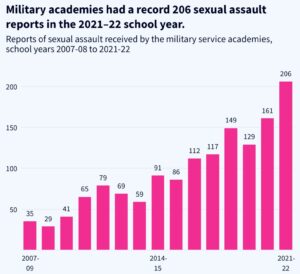
Among the many reasons for lagging recruitment is the growing public recognition of facts about high rates of sexual assaults in the ranks, mainly against women, for which there has been too little meaningful redress. Further, recent reforms that passed Congress have been cut back and inhibited by the current administration. Young American women know about this, and increasing numbers vote with their feet.
Further, military suicides for numerous years have exceeded combat deaths in Iraq and Afghanistan and are still at record levels. This is a long-running national scandal/epidemic [see “A Disaster of the U.S. Military’s Own Making, by The New York Times.]
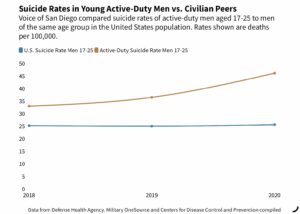
Both these chronic plagues and their bad publicity are all too rarely identified in official documents. And indeed, neither “suicide” nor “sexual assault” are ever mentioned in the Guide.
Not directly. Yet the chaplains who wrote it are the troops who deal with these eventualities up close and most often, as key duties. Their long term, too often tragic impacts hover over the Guide on almost every page. Consider how the following sample statements set a theme that first speaks of the battlefield, but in fact looks far beyond it [emphasis added]:
Lieutenant General Kevin D. Admiral, Commander, III Armored Corps: “When our Soldiers are grounded in spiritual health, driven by purpose, and connected to one another, they will excel in life and prevail in war.”
That’s on the cover.
Major General William Green, Commander of the Chaplain corps: “This guide symbolizes 250 years of the Chaplain Corps standing shoulder to shoulder with you … Our Army leaders … must be equipped to lead Soldiers to success in war and life.”
Meaghan B. Simmons, Regimental Sergeant Major of the Chaplain Corps: “Use this tool to enhance your understanding of spiritual fitness; it is crucial to well-being and operational effectiveness. This guide offers perspective into strengthening the spirit through field-validated lessons learned that prepare formations for war and life.
The above two are in the Preface.
Page 7: “Army leaders cannot afford to fail in creating spiritually fit formations. Spiritual Fitness is the conditioning of a Soldier’s spirit towards readiness—to fight and win in war and life.
Page 74: “Team leaders must be adept at recognizing signs of stress, burnout, or spiritual struggles in team members. … Failure to intervene with these signs can result in more serious individual and unit consequences.”
Prior to publication, Chaplain Dustin Hall, a principal author, added: “What we think the spiritual fitness guide brings to a Soldier’s day to day life is an ability to prepare for war and withstand life’s challenges.”
I hope the pattern is clear. There are many more variations on the “winning in war and life” theme. In fact, much of the book is taken up with ideas and exercises for individual and group spiritual self-care, both in preparation for fighting, and then post-combat care “for those struggling with the emotional and spiritual aftermath of traumatic experiences, moral injury, or grief.” And yes, too often suicides and sexual assaults. [P. 84]
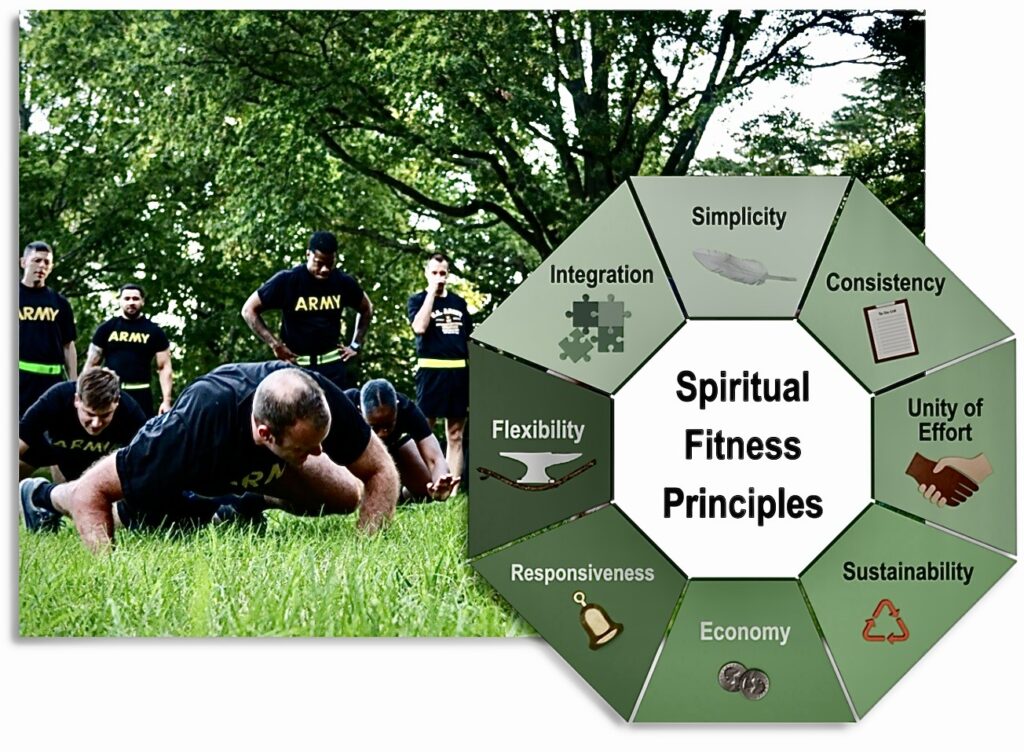
Among the tools here are some redolent of what has been called “New Age” practices, though rather mild. Despite Hegseth’s scorn, they do have their adherents in uniform as well as out. They are likewise included under the broad umbrella of the First Amendment’s “free exercise of religion” principle, which, after all, applies also within the military. The authors affirm this steadfastly here, if the Secretary does not.
At the base of their schema they posit that spiritually healthy persons find a “Source of Strength”:
A source of strength is the internal, driving purpose that empowers each Soldier, anchoring them amidst the challenges of life. This source is chosen by each Soldier as the centerpiece of their life’s direction. Soldiers choose a source based on their personal values, beliefs, experiences, and cultural backgrounds.
From an operational perspective, the Soldier’s source of strength fuels their purpose and will to fight. For some, the centerpiece may be God, family, community, or patriotism; for others, it may stem from a desire for personal growth, integrity, or the bonds formed with fellow Soldiers in shared experiences. (P..15-16)
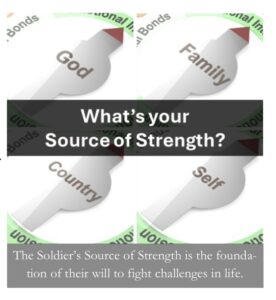 [NOTE: Hegseth’s anger at the Guide seemed to boil over when he found it mentioned God but once, above. [In this he is only half right; there is a second mention of God, in a graphic on the next page. Further on page 47 it speaks of a “deity” as a Source; to me that would be at least half of a third.]
Still, while affirming the wide variety of spiritual “Sources” and beliefs based on them, the Guide adds an incisive and haunting caveat:
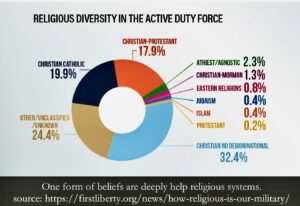
However, the very nature of beliefs can also introduce caution. When beliefs are formed without logical examination or are rigidly adhered to, they may lead to dogmatism or bias, preventing Soldiers from adapting to new situations or considering alternative perspectives.
This inflexibility can hinder critical thinking, potentially resulting in poor decision-making in high-stakes scenarios. Moreover, external influences can also lead to the adoption of beliefs that may not align with the core values of the Army or the principles of ethical conduct.
Consequently, Soldiers must cultivate an awareness of their beliefs, embracing those that genuinely resonate with their convictions, while remaining open to reevaluation in light of new information and experiences. By balancing conviction with rational inquiry and spiritual guidance, Soldiers can harness the strength of their beliefs while mitigating the risks associated with blind adherence, ultimately strengthening the core of their spirit. (P. 20)
This is counsel the Secretary might well weightily consider, as he oversees whatever is to replace the Guide. For that matter, despite all its attention to spiritual development for the noncombat rest of life, the Guide does not forget that its intended readers, whatever their various “Sources of strength,” have the book in their hands (or on their screens) because they are warfighters. Indeed, the authors repeat this often:
Sergeant Major Simmons insists that its program: “embodies our Army’s commitment to building a strong foundation of spiritually healthy, purpose-driven Soldiers and Families. When Soldiers derive purpose from their source of inner strength and collective mission, they become unstoppable in war.” (P. 3)
“Unstoppable”? (Well, there goes the notion the authors are undercover Quaker pacifists, with their ubiquitous “War Is Not The Answer” bumper stickers.)
And its Glossary (P. 100) baldly defines “Spiritual Fitness” as “The condition of a Soldier’s spirit toward readiness to fight and win in war and life.”
After working through the Guide from my outside and very different perspective, I appreciate the labor that went into it, and the numerous tightropes the authors had to walk as they carried it to completion. They report spending about eight months in drafting it; I know of few Quaker committees which could reach agreement while matching that pace. (But of course, we are thankfully not running the Pentagon.)
Further, I wish the Guide had been given more of a chance to percolate through the ranks – all the services could benefit from it. Indeed, I believe it could save lives.

Beyond that, there is much here, I feel, that many of us civilian Americans could usefully ponder. Admittedly I’m not very sanguine about what Hegseth might replace it with. And — what was that comment in his War on Warriors book about the U. S. military being turned against the American people?
But about that also, time will tell.
Here again, is the link: https://tinyurl.com/2tyj4j23
“There’s not to make reply, there’s not to reason why,
there’s but to do and die. Into the valley of death rode
the six hundred.”
-Alfred Lord Tennyson, as quoted on page 18 of the Army Manual. Compare it to the original of Stanza 2 of Tennyson’s actual poem:
“Forward, the Light Brigade!”
Was there a man dismayed?
Not though the soldier knew
Someone had blundered.
Theirs not to make reply,
Theirs not to reason why,
Theirs but to do and die.
Into the valley of Death
Rode the six hundred.
Someone blundered. “There’s” and “Theirs” are different words with different meanings.
But someone blundered worse when they let the Emperor Constantine weaponize Christianity. Jesus taught, “Love your enemies.” In fact He disarmed Peter when armed men came to arrest Him the night before His crucifixion. It remains important for followers of Christ to insist that Christianity armed is Christianity falsified.