
Communists & Quakers
The Redbaiter-In-Chief hasn’t said it yet, but he could: Quakers and Communists go together like kale and potlucks.
It’s not a new story, or set of stories. Until this summer I wouldn’t have mentioned them other than for occasional nostalgia value. But then in June, # 47 yanked a rattling skeleton out of the rightwing Bugaboo Closet, and has since tried to revive it into a new Red Scare.
(That’s scarlet/crimson as-in-Commie, the color of flags used by many 19th century European revolutionaries, not —until now— part of the current 4-letter ballcap version. But if the ballcap fits . . . ?)
On the eve of July 4th, #47 let loose in typically bloated terms:
“We see our American identity under a renewed attack, a generation after we fought and won the Cold War against the menace of Communism.
There is now a resurgence of the Communist menace in our land, including from newcomers to our country who embrace ideas totally opposed to our way of life and our great success. These are not mere political disagreements like differences over taxes or regulations.
Communism is a mortal threat to American liberty. It is the greatest threat to our country, including World War I, World War II, Pearl Harbor, or even 9/11.
We’re not going to let this happen to us. Believe me, we’re not letting it happen, because communism is the enemy of free people everywhere, everywhere in the world. Never works.”
That blast ricocheted off the granite visages of Mt. Rushmore brooding behind him in South Dakota’s Black Hills. There has been much more since, which we’ll skip for space.
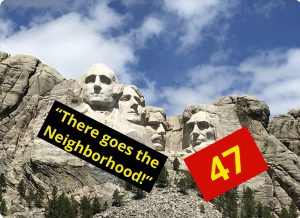
So far, though, as summer 2026 crests, these change-the-subject ploys don’t seem to be stirring up the desired public panic and outrage he’s after. But the winds of opinion can change rapidly, like the sinuous airstreams spreading smoke and flames over half the continent.
Maybe one retardant thus far is the fact that the “threat” is 99+% baloney. The Communist Party is still a legal entity, Also: (cpusa.org) — but it’s hardly a significant political actor. Democratic Socialists (e.g., Bernie Sanders, Zohran Mamdani, et al are much more numerous, but not the same, and that’s another matter:
Bernie in 2020: “I am not a Communist, that I presume the president [Trump] knows the difference — maybe he doesn’t . . . .” He also said: “When I talk about democratic socialist, I’m not looking at Venezuela. I’m not looking at Cuba. I’m looking at countries like Denmark and Sweden.”
Trump’s equating the two is an old ploy which has sometimes worked. But while the difference is real and important, we’ll not get into the weeds of it.
So once upon a time (actually more than twice upon a time) the Red Scare was Topic Number One in the U. S. for months. In its wake, some went to prison or into exile, a couple were executed, others lost careers, and millions lived for years in real fear.
Not only that, but Friends, many U. S. Quakers were all over it. All over it, from just about all sides.
Here’s a sketch of a partial list, from right to left.
In the first Red Scare, one of the most-remembered figures was a distinguished Friend, with a polished Pennsylvania Quaker lineage, a Swarthmore College degree, and a bright political future. Now he’s remembered only for searing his name on that first nationwide anti-Communist sweep.
Yes, I speak of the notorious “Palmer raids” of 1919 & 1920, in which thousands of immigrants were snatched with little regard for warrants or other niceties, thrown into crowded, often filthy jails, no bail, and many deported. It was ICE without the style sense.
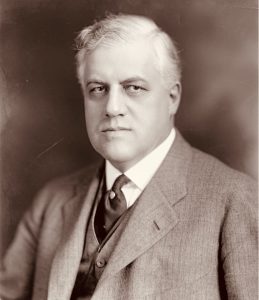
This dismal project was the brainchild of A. Mitchell Palmer, (1872-1936) U. S. Attorney General under President Woodrow Wilson. A Pennsylvania native, Palmer was Quaker and not a merely nominal one. As a congressman, he had been a featured speaker at the 1910 Friends General Conference, and his text showed familiarity with his subject.
The pretext for his raids was a belief that Communist and anarchist infiltrators (mainly recent immigrants) were planning an armed uprising in the U. S., modeled on the still new, successful 1917 Russian Revolution — on or around the Marxist holiday, Mayday (May 1) 1920.
Palmer’s previous political record had mainly been as a progressive Democrat.
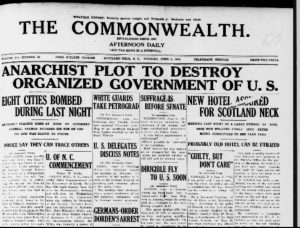 But then a bomb exploded at his Washington home on the night of June 2 1919, almost killing him and his two sleeping children. That attack changed his outlook, and why wouldn’t it?
He vowed that the feds would hunt down whoever had planted the bomb — one of many scattered terrorist attacks in those years, most likely by militant anarchists (not the same as Communists; but that too is another distinction typically ignored by its exploiters.
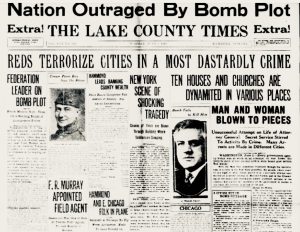 Palmer also hoped to ride a successful purge to election as president to succeed the ailing Woodrow Wilson.
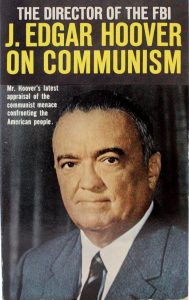
The report about a Mayday armed rebellion was spread (maybe concocted) by an aggressive young lawyer named J. Edgar Hoover. Palmer had appointed Hoover to the government Bureau of Investigation (BOI) Hoover soon was made the first Director of its successor, the FBI. His anti-Communist crusade lasted 48 years, until his death on May 2 (the day after Mayday), 1972 .
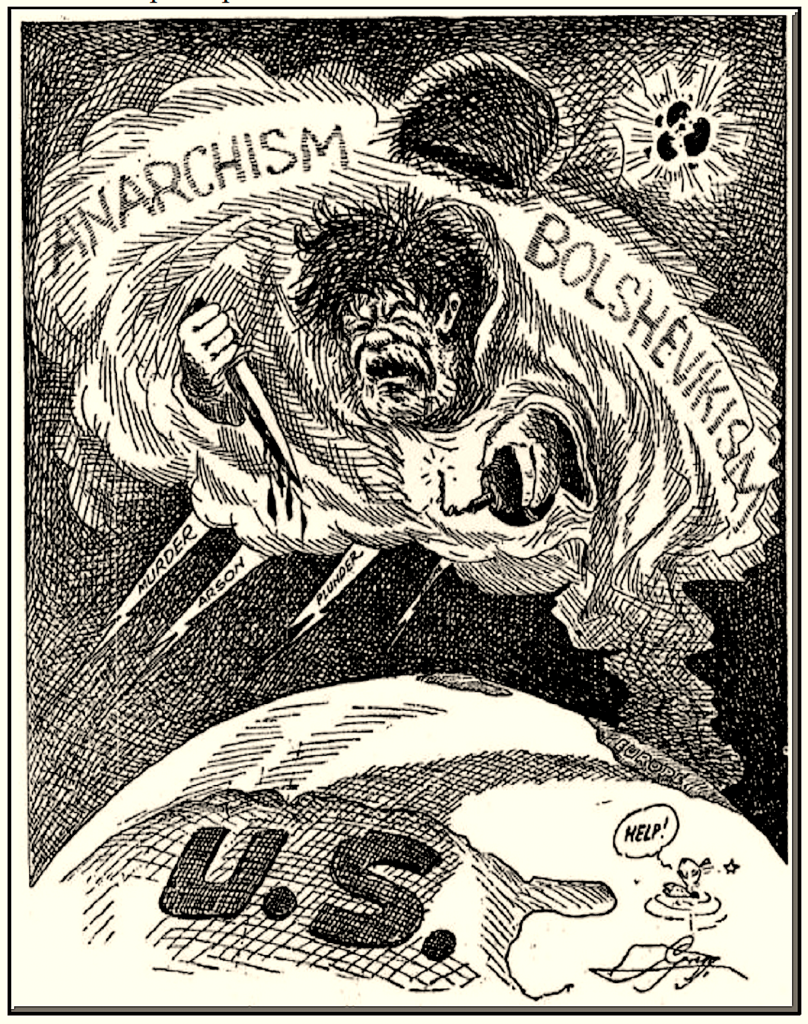
While the “Palmer Raids” launched Hoover’s career, they put an end to Palmer’s. It turned out the bombs did not herald an attempted uprising. Some radicals dreamed out loud about one. A few planted bombs to promote it. But their numbers were very small, their organizations anarchic and quarrelsome, and plans were mostly fantasy. Their blasts sowed terror, caused numerous injuries and a handful of deaths, but never seriously threatened the American system. (For that matter, Hoover’s agents could not find anyone to arrest for bombing Palmer’s house.)
After the great uprising was a no-show, federal judges threw out most of the raids’ arrests for lack of evidence, and Palmer’s raids were discredited. His presidential hopes also fizzled.
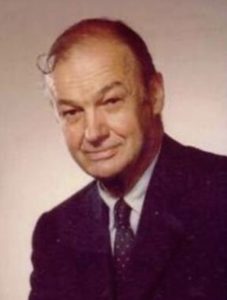
But Palmer had company in the Quaker anti-Communist amen corner. One other significant emerging figure was Henry Regnery, a Quaker-adjacent publisher who married a committed member of the Quaker Scattergood family, and was associated with the American Friends Service Committee in its early days.

Regnery founded the pioneering midcentury conservative paper Human Events (in 1944; still appearing online) and Regnery book publishing (1947; still operating). Regnery issued the first book by William F. Buckley and promoted numerous other leading “Old Right” figures.
There were others, not least the two Hoovers: Quaker president Herbert Hoover (no relation to J. Edgar), who was fiercely anti-Communist even when he was running a massive feeding program in the early 1920s that saved many hungry Russian children. He also founded the Hoover Institution at Stanford University in 1919, as a pioneering think tank. Forty years later, Hoover —old but still active — renewed its charter thus:
“The purpose of this Institution must be . . . to demonstrate the evils of the doctrines of Karl Marx whether Communism, Socialism, economic materialism, or atheism—thus, to protect the American way of life from such ideologies [and] their conspiracies . . .” Which it continues to pursue today.
So that’s a quick glance at one end of the Quaker-Communist spectrum in the U. S. There were Quakers at the other end, too.
Oh, yes indeed.

Among them was Bayard Rustin (1912-1987) who as a young Quaker radical had joined the Young Communist League in New York City in 1936, drawn by the party’s struggles against racial prejudice. But after World War Two began, he left the Party when, under orders from Moscow, it abruptly dropped its previous antiwar stance after Hitler invaded Soviet Russia in June 1941.
Many American intellectuals, labor activists and some workers followed paths similar to Rustin, during and after the dismal years of the 1930s Great Depression and the second world war, joining and ultimately leaving the Communist Party. So did some Friends. But there were also those who remained on the other side. Two eventually became famous.
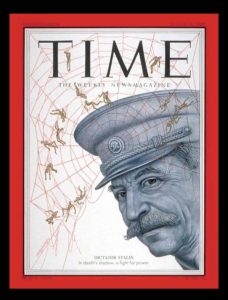
The Red Scare was paused during World War Two. After all, President Franklin Roosevelt, no Communist sympathizer, had joined with Soviet Russia, now ruled by the ruthless Joseph Stalin, to defeat the Axis powers, Hitler, Mussolini and Japan. But soon after victory in 1945, the U. S. – Russia alliance fractured into what became a forty-year Cold War, pitting the capitalist West (aka the “Free World”) against Communist Russia (& later “Red” China, as it was called all through my youth in the ‘50s-early ‘60s).
This split soon became a nuclear standoff, punctuated by smaller hot wars in Korea and Vietnam, plus various CIA coups in Iran and other countries.
Inside the U.S., the Cold War was accompanied by a revived Red Scare, which lasted from 1947 into the late 1960s.
A Mitchell Palmer was gone (died in 1936) but his protege and heir, J. Edgar Hoover and the FBI, were still steadily beating the drums. Yet Wisconsin U. S. Senator Joseph McCarthy (1908-1957) was the biggest star of this new show.
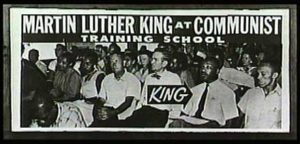
Rather than an armed uprising, Hoover and McCarthy warned of subversion and espionage. Swarms of Communists were now burrowing from within, they said, and like termites gnawing the pillars of a neglected building, threatened to bring on an internal collapse.
J. Edgar Hoover also supported segregation and southern white supremacy, and his
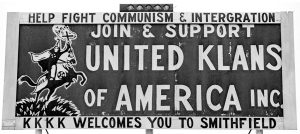
anti-Communist campaigns expanded to include spying on and disrupting the growing postwar civil rights movement, which he firmly believed was a creature and tool of the Kremlin.
McCarthy and his supporters also charged that the Roosevelt administration had been specially honeycombed with Communist infiltrators and spies. He insisted they were still shoveling American secrets to Russia and Stalin through the Harry Truman presidency and into the Dwight Eisenhower administration.
For awhile, much of the public believed them.
And they weren’t all wrong. There were indeed some Communist spies sending U. S. Government secrets to Moscow, including designs for atomic weapons. A number were caught; they faced a series of sensational scandals and trials. But many thousands of loyal Americans, some former leftists, were also investigated, harassed and in many cases their careers ruined, without cause; but these dramatic stories are not our subject here.
Except for three, who were Quakers. And two more, who almost were. Plus some others, once close to some of the three, and who (mostly successfully) wanted everyone else to forget that fact.
The second-best known of the three was Whittaker Chambers (1901-1961), a writer who became a certified Communist in the 1930s and a spy for Moscow. Eventually disillusioned by Stalin’s savage dictatorship, he quit spying and left the party. During his exit, he had a profound religious experience, and by 1943 had become, quietly but apparently with great sincerity — a Quaker.
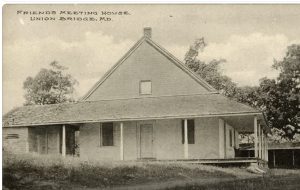
In 1943 Chambers joined Pipe Creek Meeting, a tiny group in rural Maryland, with a small out of the way meetinghouse. Chambers reveled in its silence and seclusion.
As a Quaker, he felt called to bear witness to his truth, and that led him in August 1948 to appear before the U. S. House Un-American Activities Committee. In his testimony, he named a Washington lawyer and diplomat, Alger Hiss (1904-1996), as a fellow spy.
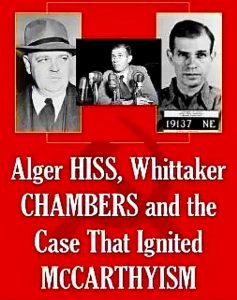
Hiss vehemently denied the charge, sued Chambers for libel, and testified in turn. The subsequent controversy resulted in, among other things, Hiss being imprisoned for perjury, national stardom for an obscure rookie Congressman named Richard Nixon (1913-1994), who was convinced Hiss was a liar and a traitor, and enormous sales success for Chambers’s 1952 autobiographical book, Witness.
Hiss never admitted to being a spy, and arcane debates over whether it was Chambers or Hiss who was lying, and if Hiss was being framed, continue. My own view is that Hiss was a spy, but I won’t go any further down that rabbit hole now.
The point here is twofold: first, the Hiss-Chambers furore lasted several years, and was pivotal in the rise of the Second Red Scare. That much is generally agreed.
But few of its many chroniclers have noticed an almost eerie fact: how many Quaker connections the case involved. Yet they are indisputable, and illuminating to a careful and informed Quaker reader. Among them:
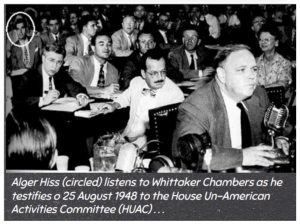
— Chambers, whose turnaround from being an atheist Communist spy took him into Christianity. Yet not to the evangelicals or Catholics , but into faithful Hicksite Quietist liberal Quakerism. There he was fulfilled by its worship and satisfied with its obscurity. He wrote eloquently of it in the pages of Witness, passages that almost all reviewers ignored.
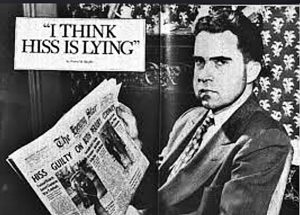
—Richard Nixon, by far the most famous (notorious?) American Quaker of the last half of the 20th century. In Congress, Nixon was convinced by Chambers’s testimony, then skillfully rode the pursuit of Hiss into the national spotlight. He vaulted in four years from backbench obscurity via the U. S. Senate, to the Veep slot with Dwight Eisenhower in 1952.
Digging under the surface of his meteoric rise, a distinguished Quaker historian, H. Larry Ingle, showed how a major goal of Nixon’s political turn was to escape and erase a full-bore evangelical Quaker upbringing in southern California. Ingle’s 2015 book, Nixon’s First Cover-Up (U. Of Missouri Press) unpacks this process in painstaking detail. And then, not least, there’s
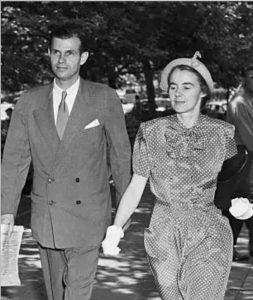
—Alger Hiss himself. Not a Quaker —yet at least a fellow-traveler. Before the case he was a frequent collaborator and resource for the American Friends Service Committee, and in particular its longtime head Clarence Pickett (Executive Secretary 1929-1950).
Further, his wife Priscilla had graduated from Quaker-founded Bryn Mawr College, and attended Meeting in New York. The couple had adopted some telltale Quaker features: for instance, they addressed each other privately as “thee” and “thou.” (Excerpts of letters with this usage are in Meyer A. Zeligs, Friendship and Fratricide: An Analysis of Whittaker Chambers and Alger Hiss [New York: Viking Press, 1967]. )
These tender pronouns were perhaps the last lingering remnant of Quaker “plain speech.” But they could still be overheard between members of families with long Quaker connections. And I (not a “birthright” Friend) heard them occasionally in the late 1960s.
The burgeoning Second Red Scare could have undermined what was the classic period for AFSC: steady growth in size and influence. When Clarence Pickett became a personal friend of and sometime informal advisor to First Lady, Eleanor Roosevelt, his prestige among eastern liberal Friends became ne plus ultra. “In 1956, a national Quaker publication* assessed him “as probably the best known and widely acclaimed leader in the Quaker field at present.”
*[Jane P. Rushmore, “We Are Growing Together,” Friends Journal, (26 May 1956), 327.]
The capstone of this period was AFSC’s being awarded the Nobel Peace Prize (jointly with British Quakers) in 1947; they have since been basking in its reflected glory for nigh on 80 years.
The Nobel medallion had hardly lost any luster when the Hiss case burst on the national scene in August 1948. Pickett and AFSC leaders were astounded and put on the defensive. Hiss was not only familiar, he had also opened doors to many lofty Washington circles: the State Department, the new United Nations, and later when he was head of the Carnegie Endowment for International Peace.
Further, they were put off by Chambers on social and class grounds: Hiss had degrees from Johns Hopkins and Harvard law; in appearance he was not flashy but always impeccable.
By contrast, Chambers had no degree, his suits were rumpled and threadbare; his teeth were bad, moods melancholy, and his national profile was nil.
How could Pickett and his peers support their old ally and colleague Hiss, while preventing AFSC from being tarred with the broad brush of suspected subversion being wielded by Nixon, McCarthy and others?
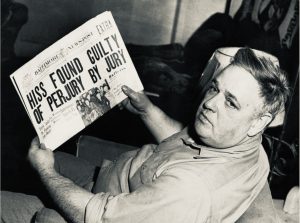
Pickett met privately with Chambers, proposing to mediate a pretrial settlement of the Hiss libel suit; nothing came of that. Later Pickett took the stand as a character witness at Hiss’s second trial for perjury in 1950 (his first trial had ended in a hung jury). Hiss was convicted and served three-plus years in prison.
Historian H. Larry Ingle contends that after Hiss’s conviction, AFSC’s Clarence Pickett worked to erase Hiss’s connections to his elite Quaker contacts.
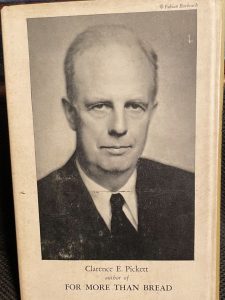
Pickett also published a short dismissive review of Chambers’s book Witness, which, Ingle says, “had the effect at least of warning readers that they should not take Chambers’s views of Quakerism seriously, and at most suggesting to Friends that he was not, as far as theology was concerned, a real Quaker regardless of his membership.”
And in Pickett’s 1953 memoir, For More than Bread: An autobiographical account of twenty-two years’ work with the American Friends Service Committee, Ingle notes that “It is impossible to tell for sure how Pickett and his many Friends reacted to the overall Hiss-Chambers case with its long aftermath, but it does seem significant that neither Chambers nor Hiss–or for that matter, even Nixon–is mentioned in Pickett’s memoir, possibly because Pickett considered it unimportant to the central events of his life or because he hoped people would put it all behind them, as he had evidently tried to do.”
But Chambers needn’t have worried. After Witness peaked and dropped from the bestseller lists, the fellow-traveler conservative publisher Henry Regnery stepped up and kept the book in print.
One other Quaker unmentioned by Pickett did appear in Chambers’s testimony: Noel Field (1904-1970), another one time Washingtonian who Chambers said was spying for Moscow alongside him.
While named, Noel Field did not figure directly in the Hiss case. But Chambers was telling the truth about him spying, at least; we have Field’s own testimony for that.
The Hiss investigators didn’t question Field, however; not least because they couldn’t find him. He had left the U. S. In 1936, to work for the League of Nations in Geneva, and never returned.
But being unnoticed in Washington did not mean being insignificant in history.
Raised a pacifist by a Quaker father, Field had the right credential, a Harvard degree, and strong anti-fascist feelings.
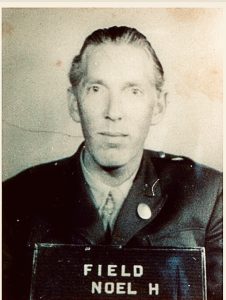
Like a surprising number of well-born educated youths in those years, he was attracted to Communism as a way of opposing Nazism. In Geneva he worked with many refugees from the Spanish Civil War, many of whom were inspired (and later betrayed) by Stalin’s pretended show of support for the Spanish anti-fascist struggle.
Field was not shy about trading on his Quaker identity; yet he had also decided, by his arrival in Geneva, that Communism was the right form of applying Truth in his world. Like Alger Hiss, he was once a promising State Department official; indeed they were good friends. And Field was willing to gather intelligence (aka spy) for the cause. But Field apparently shrank from the underground’s request that he spy on his own government.
To resolve his hesitation, Field left the US, for Europe to work for international organizations. There, he later said, he could spy for Russia with a clear conscience, since he was not working for any government in particular.
During World War Two he was hired by the Unitarian Service Committee to head its European refugee program in southern France. Unbeknown to his employers, he used it mainly to help Communist activists escape from Nazi territory. While he later denied that he only helped Communists, his work was clearly biased toward them, and there were many such on the run from Hitler. Some of them later became key figures in the Moscow-supported satellite governments of postwar Eastern Europe.
Once Whittaker Chambers spoke publicly of Field’s Communist past, his cover was blown. He was soon cut loose by the Unitarians, and was afraid to return to the U. S. and its ravenous red-hunters. Now out of work, in 1949 he went to Czechoslovakia, where he thought he had been promised a teaching job at its Charles University.
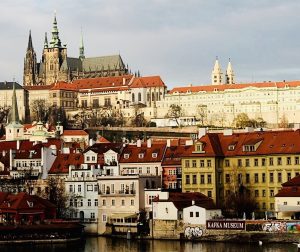
But rather than escape a threatening witch hunt on the far side of the Atlantic, he walked right into a different, far more terrible one on the other: in Prague, he was arrested by the Communist Czech secret police, and spent five years in prison without charges or trial.
His wife Hertha, who soon came searching for him, was also imprisoned nearby, but neither knew if the other was still alive.
Why the prison cell for such a Communist loyalist? His dedicated refugee work during the war –while melding his Quaker past with current ideology–had also put him on Joseph Stalin’s paranoia-tinted radar screen. Stalin deemed him to be the centerpiece and spymaster of a paranoid fantasy about a farflung American plot to overthrow his new East European dominions.
On this delusion was built much of the long horror of Stalin’s postwar purge trials, after which many were executed, tens of thousands imprisoned or tortured, and millions of eastern Europeans left living in terror of being charged with the wholly imaginary crime of being “Fieldists.”

The only evidence against many of the victims was that Field, the devout Communist Quaker, had helped them escape the Nazis and therefore had met them. (Which brings to mind the cynical adage, No good deed goes unpunished).
Field himself insisted he knew nothing about any such plan, but was tortured into making a false confession. Then he was returned to solitary confinement in a basement cell for more dark years.
A brief account of these purges was in a 1974 book, Operation Splinter Factor by Stewart Steven; Noel Field’s sad story is told well by Flora Lewis in her 1965 book Red Pawn; and vividly in 2016 by Kati Marton in True Believer: Stalin’s Last American Spy. Field’s own account is, “Hitching Our Wagon to a Star,” was published in Mainstream (January 1961) .
One would think such treatment would have disillusioned Field. But incredibly, it did not. He and his wife came out of prison and reunited after Stalin’s death in October 1954. (The next month, November 1954, Alger Hiss was released from federal prison in Pennsylvania, still protesting innocence.)
Field emerged to avow his forgiveness of his misguided captors and publicly reaffirmed his unshaken faith in Stalinist Communism as the true way to the world’s best future. He and Hertha settled in Budapest, he defended the Soviet invasion of Hungary in 1956, and he died there in 1972.
Field’s narrative, in fact, reads like nothing so much as an updated version of the “sufferings” of many an early Friend who emerged from horrible ordeals with their faith refined as by fire, praying for their persecutors as much as for other victims.
Noel Field is all but unknown today, while Chambers remains, at least to Americans like Ronald Reagan and a few old-school Never Trumpers, an icon and heroic martyr figure. To Friends, both these men’s stories, and those of others like Clarence Pickett ought to provide much food for sober reflection on the meaning, the ambiguities and the still-explosive implications of this tradition they hold so dear.
Once Quaker conviction gets loose in the world, especially if it is made the victim of a false god, not just an individual but whole societies can be put at risk. It was not for nothing that the apostle Paul charged his fellow believers (in Philippians 2:12) to “work out your salvation in fear and trembling.”
And now, more than three decades after the fall of the Berlin Wall and the dissolution of the USSR, a U.S. President is once again pressing for a Red Scare, trumpeting the threat of Communism as one of the biggest issues facing American voters.
According to a TIME analysis, Trump invoked communism 94 times in public remarks and social media posts between June 25 and mid-July. He conflated it with the Democrats, describing many of the party’s candidates as “hardcore, godless Communists.”
In a mid-July anti-communist conference at the State Department, Secretary of State Marco Rubio announced that the Communist world HQ had moved from Moscow to Havana.
Cuba? Where they can’t keep the lights on, or the refrigerators cold? We’re supposed to be terrified?
White House Deputy Chief of Staff Stephen Miller, who is closely involved in #47’s crusade for ICE-fueled mass deportations and fast-track construction of the world’s largest gulag system, followed up and echoed #47’s calls. Miller also spoke of plans for federal action against nonprofit groups which he said are supporting or defending a supposed rising tide of alleged left-wing terrorism and violence. He also denounced judges and juries who have been getting in ICE’s way, by throwing out charges which lack such trifles as warrants, evidence and legality.
No wonder some members of the federal judiciary, including even Supreme Court justices, are calling for enhanced security due to the volume of credible threats of violence against them.
Yet actual Communists are extremely scarce in America these days, and couldn’t mount anything like the Jan. 6 MAGA assault on the capitol. Their website is cpusa.org .
For that matter, #47’s “hardcore godless” Communists are even scarcer.
Who says so? The Party. It now has – believe it or not –an official “Religion Commission,” which has unrolled a big , um, red carpet:
Person of faith? The Communist Party welcomes you!
There is so much misunderstanding of the relationship between religion and communist views. More often than not, people only associate communism with atheism due to misquoting Marx in his comment of religion being the “opium of the masses.” Due to misquoting and misinformation, the general thought has been that no one of religious faith or practice could possibly be a communist and vice versa. This is simply not true.
. . .There’s nothing in Marxism as a way of understanding society and social change that is incompatible with whatever religious faith you may hold. The views, voices, and efforts of progressive people of faith are in harmony with the goals of our Party, especially in regard to seeking peace and justice for all. The doors of the Communist Party USA are, and always have been, wide open to people of faith. . .
We have people at all levels of the Party who are active in their communities of faith and it’s because of this that a commission was created several years ago for religious members of the Party to work together. . . .
(Well, butter my butt and call me a biscuit; the Commies finally found God. Bless their furry Marxist hearts. Or at least, they found a use for Him—err, Them.)
And “misunderstanding”?? Well, there’s a whole lot of Marxist atheist history and policy stuffed down between the cushions in that big couch of a word choice; but we’ll let them explain that away some other time.
And DSA, with its much larger membership, is keeping pace – it too has, on the second level of its site, a “Religion and Socialism Working Group” . . . open to DSA members of all faiths whose socialism is in some way inspired by their spiritual identity.
There is a long tradition of religious socialism in the United States that has been ignored or forgotten. The Religion and Socialism group of DSA refuses to cede the ground of faith to the religious right. . . .
You betcha DSA! And if anyone there really decides to STOP ignoring & START recalling—it has more than 100 years of non-communist Social Gospel stuffed in their attics and closets, along with a scrapbook featuring snapshots of some real superstars, like Martin Luther King Jr.
But are there any Quakers nowadays swinging above their weight in either of these groups?
My guess is there are some DSA-at-least-fellow-travelers in the NPR-liberal wing of Friends; and might be a few even flirting with the CPUSA. But these judgments are more reliable when made in retrospect. After all, Whittaker Chambers and Noel Field never wanted to be famous; and A. Mitchell Palmer was hoping to be remembered for something very different. Nixon alone managed to climb the greasy pole; but his career did not end well.
Reading the transcript of the mid-July State Department confab, it wasn’t clear to me, as to what kind of green light Stephen Miller and Marco Rubio are looking for: it sounded like they’re lusting to loose a wave of ICE-inspired “enhanced enforcement” untrammeled by due process on the large numbers of us, native citizens, that polls suggest are at least sympathetic to many of the points of the DSA’s program. A clampdown on progressive nonprofits too (including churches)? Either those or an invasion (or better, a relief mission) for Cuba.
Thus far #47’s “Communist” labeling seems only to stir the reflexes among a thinning slice of voters — mostly members of my “Generation OTWO” (On The Way Out) who can still remember the name Hoover as attached to something other than a big dam on the Colorado River, or even a vacuum cleaner. There aren’t that many of us left.
Maybe the green light will flash if the midterms don’t go the way Rubio/Miller and the Boss want. Or the Epstein Files coverup slips. Whatever its form, if the Third Great Red Scare really takes off, it won’t be pretty. And few of us Quakers will be any more ready for it than Noel Field was when he showed up in Prague for a friendly-sounding job interview.
Meanwhile, at the other end of the spectrum, it looks like status quo: The Hoover Institution Press is keeping the faith: bringing out the expanded memoir of the guy who ran the Czech Stasi internal spy service when the whole commie government. collapsed. And on the other, at Regnery Publishing, Whitaker Chambers’s Witness is still in print after 75 years, now in an expanded edition, as a certified “Cold War Classic.”
The more things change . . . .
Fantastic work, Chuck, about a slice of history that has so many facets that it’s impossible to believe it could all be real. And of course it is.
Thanks,Hank! Please share it with others who you think it might encourage.
Hank, I confess I might have exaggerated a bit about the biscuits; but the rest of it should stand up pretty well.
Chuck
This is brilliant! Thank you. As an 82-year old NPR-liberal, former (maybe) Quaker, current more-or-less Unitarian-Universalist, with a long memory, whose uncle was fired from the State Department because he was a China expert, this was an absolute joy to read. Including the spectacular “Butter my butt and call me a biscuit” part. Thanks for bringing lots of new information and a bit of joy into my day!
Thanks to thee, Barbara! I tried the U-Us, but liked the quiet better. Yet my Quaker hero, Lucretia Mott, learned much from Channing & Parker, and I’m still learning from her. I invite you to share the piece with others you think might enjoy the biscuits!
This warms the very cockles of my heart. As a Quaker (Multnomah MM) and a 10-year DSA member (I joined the evening #47 was first elected) as well as having flirted with CPUSA (I even led a couple of book studies at the LA CPUSA office), I identify with Whittaker Chambers a bit.
I was raised in Oregon Yearly Meeting in a VERY anti-commie environment, singing Onward Christian Soldiers and Battle Hymn of the Republic frequently in our little Rosemere Friends Church. In high school, I lived with my uncle and aunt, who were strong supporters of the John Birch Society, and became a member of Big F, Newberg Friends Church, after signing a creed, the Richmond Declaration of Faith. Our. Paster was (IIRC) Charles Ball, who was quite proud of being Richard Nixon’s mother’s pastor.
So I am more than familiar with that branch of Quakerism.
Fortunately, when I went to George Fox College, Lewis Benson came to visit and I was inspired to really take up the early writings of the Friends, especially Robert Barclay, and discovered (not from Friend Benson) that if I looked at these early writings from a universalist perspective, they spoke to me deeply and I became Convinced and found the Religious Society of Friends.
These days, I attempt to live by Matthew 25:34-45 and I work for peace and justice. If I am called in front of a new version of the HUAC, I hope that I will be able to speak my truth and maybe even help the GOP and Corporate Democrats find their own truth.
Again, Chuck, I thank you for your long and consistent witness and for providing me with an example of a Quaker life well-lived.
Thanks so much Ron, for the warm words and very informative comments. I believe there’s a major untold story about overlap in OYM/NWYM and far-right “Christian” groups like John Birch & others, many enamored of guns & secession, and now moving toward naked theocratic schemes being peddled & seeded by by Doug Wilson, Pete Hegseth & his ilk.
I invite you to share the piece with any others you think may find it encourading.
Great article!
I am sorry that Bernie Sanders is so ignorant about democratic socialism. Sweden and Denmark are social democratic, unlike democratic socialist Norway. In Norway, workers, communities and the state own and control resources and the major means of production – oil, gas, steel, telecommunications, electric generation, and much, much more. The Norwegian Sovereign Wealth Fund has $2.3 trillion in assets. No social democratic country has a sovereign wealth fund. They own shares in more than 9,000 companies worldwide, 1.5% of all publicly traded shares in the world. Not a single one is owned by a capitalist. So UNLIKE Denmark and Sweden.
Norway is also the happiest country in the world. It isnt because they eat rutabagas morning, noon, and night.
As for Democratic Socialism, Bernie, you should read the definition provided by DSA in their Constitution:
Article II. Purpose
We are socialists because we reject an economic order based on private profit, alienated labor, gross inequalities of wealth and power, discrimination based on race, gender identity, sexual orientation, disability status, age, religion, and national origin, and brutality and violence in defense of the status quo. We are socialists because we share a vision of a humane social order based on popular control of resources and production, economic planning, equitable distribution, feminism, racial equality, and non-oppressive relationships. We are socialists because we are developing a concrete strategy for achieving that vision, for building a majority movement that will make democratic socialism a reality in America. We believe that such a strategy must acknowledge the class structure of American society and that this class structure means that there is a basic conflict of interest between those sectors with enormous economic power and the vast majority of the population.
Thank you David for that clarifying point. It made me want to make clear that I am a Democratic Socialist and not a Social Democrat. I don’t believe I own anything in the long run – I am merely a steward of my possessions, which – in the long run – belong to my family and my communitty.
An interesting point about the DSA that you did not make is that the DSA is made up of chapters (I am a member of the Portland chapter) and the chapters may vary in their adherence to socialist dogma.
In other words, socialists, whether social or democratic, individuals, chapters, or national, generally have shared values, but may disagree on tactics. Sort of like Quakers.
Thanks for the kind words, David — please share the piece with those who might find it informative or encouraging.
And Here’s a suggestion for a Button (or Bumpersticker; maybe a Billboard?):
DSA=JLN(EFW) [Translation: Just Like Norway (Except For Winter)].