
In the military, you don’t follow your bliss. You follow your orders.
And your orders are in pursuit of a mission.
You may — or may not — understand the mission. The higher-ups sending you may not understand it either. It may even be a stupid, self-destructive numnuts scheme, FUBAR (look it up). But their vow is to follow their orders, and you follow yours . . . .

On August 1, 1943, my father, Lieutenant “Click” Fager, U. S. Army Air Forces, was ordered to join what was then the largest Allied bombing raid over Europe in World War Two. Operation Tidal Wave sent 178 B-24 bombers, carrying 1750 crewmen and extra heavy loads of bombs, from Libya to Romania.
Their mission was to smash a large oil refinery complex near the Romanian city of Ploesti. It was a major fuel supplier for Nazi and Axis forces.
The round trip was almost 3,000 miles, roughly the distance from San Francisco to Boston, crossing the Mediterranean Sea each way. The crews had practiced for the raid over north African deserts and began the flight in close formation in complete radio silence.
In theory, and on paper, the mission made elegant strategic sense: the Axis armies ran on gasoline; cut their supply of fuel: foil their schemes of conquest.
But in practice, the raid had been poorly planned, and in the air turned into a bloody fiasco. Bad weather and navigational errors disrupted the intricate formation. Then Romanian air defenses around the refineries proved much more accurate and lethal than expected.
More than half the attacking B-24s were shot down or crashed. Over three hundred air crewmen were killed or left missing; almost two hundred more were captured. Lieutenant Fager’s plane was damaged by anti-aircraft fire, but managed to limp back to Libya and crash-land safely.
He and the crew were awarded medals for valor, simply for having returned. Behind them, the targeted Ploesti refineries were only briefly disrupted, then soon recovered and their output actually increased. That means Operation Tidal Wave was a strategic failure, and it was soon largely forgotten. So it goes.

Callistus (“Click”) Fager died in 1997. He’s buried in Arlington National Cemetery.

Almost exactly 58 years after Ploesti, on the cusp of August 2001, Click Fager’s oldest son, Charles, who had been eighteen months old at the time of Ploesti, said “No thank you,” to a call to a war-related mission, this time in North Carolina.
It was, technically speaking, peacetime in America. Chuck (neẽ Charles) Fager, now 59, was at the 329th annual sessions of Baltimore Yearly Meeting of Friends (Quakers), of which he was a member, near Richmond Virginia.
His “No” came during dinner, with a new acquaintance, Chris Olson-Vickers.
“No,” he said again. “No, thank you.”
Vickers was a mild-mannered social worker. She was also a Quaker, who had agreed, perhaps rashly, to host an impecunious co-religionist in need of shelter during the mid-Atlantic Quakers’ regional assembly.
That impecunious co-religionist had been unemployed for months and was low on cash. Too strapped to board on the college campus where the yearly meeting sessions were underway, he was packing his lunches and avoiding the cafeteria.
On this evening, Chris was also feeding him dinner. With the meal she had not offered job-hunting advice; she was too cultivated for that. Rather, she was exercising a Quaker prerogative and “laboring” with him.
It was opportune, she had said, perhaps even providential, that he was unemployed and under her roof. Because she knew of a job opening. A Quaker job. One she thought Chuck had the skills to fill.
At first Chuck was all ears. What job? Where?
But at her answers, he shook his head emphatically.
“It’s called Quaker House,” Chris said. “In Fayetteville, North Carolina. Next to Fort Bragg.”

“No,” Chuck repeated. “Not a chance.”
In a more mainstream setting, this could, maybe should, have been the end of it.
But again, Chris was not simply making a helpful suggestion. Rather, she was doing religious work, in a form they both understood then — and Chuck understood better later. The fact that, to an outsider, the interaction might have sounded like an argument, did not change its essential character. . . .
Quakers call it “discernment.”
It wasn’t new. Many of the key divine-human encounters in the Bible sound a lot like arguments, if you scrape off the euphemized antique verbiage.
So, Chris pushed past Chuck’s demurral.
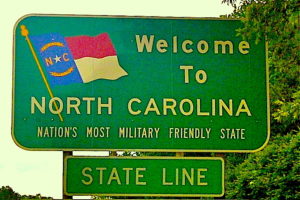 Wait, she persisted. This was not just any job. It was a Quaker peace project planted near one of the largest U. S. military bases, in the midst of a thoroughly militarized city & state.
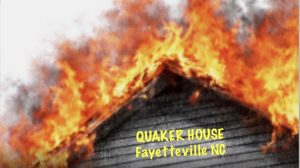
This Quaker mission had been lifting up the Friends Peace Testimony in Fayetteville beginning in 1969. It had overcome opposition, even survived an unsolved 1970 firebombing that drove the staff from its first domicile.
Since then, it had helped many dissident GIs in seeking ways out of the military — and there were plenty more desperate GI’s calling it all the time.
All very admirable, Chuck agreed. But it was not for him. There were many reasons.
At the top of the list, he readily admitted, was unabashed regional prejudice. For seventeen years, from 1977 to mid-1994, Chuck had lived in northern Virginia, which was “in the South” — despite cosmopolitan pretensions and nearness to Washington DC.
He tapped his chest significantly: That experience, Chuck told her, put him deeply in touch with his Inner Yankee.
In mid-1994, a chance came to move to Pennsylvania, to a new post at the Pendle Hill Quaker Study Center, near Philadelphia. He had leaped at it like a POW spying a hole in the gulag fence.
When the Pendle Hill stint ended, he stayed in Pennsylvania, northwest of Pendle Hill, in beautiful “Happy Valley”— home of Penn State University.
He liked the area. The woman he lived with was rooted there like an oak. They were part of a lively Quaker meeting. So why would he want to leave?
Never mind that Chuck had been laid off from adjunct-teaching English classes at Penn State that Spring; and unemployment was a pain.
Stuff happens. This too shall pass.
Besides, he persisted: North Carolina held zero appeal! Chuck hadn’t lived there, but he knew all he needed to know: it was a Four-H state —
It had Heat. Humidity. Hurricanes.

And Jesse Helms, longtime reactionary U.S. Senator.
To repeat, no thanks. Carolina could keep Senator Helms, and the rest of it.
But Chuck’s resistance didn’t faze Chris Olson-Vickers.
“You need to apply for this job,” she said again. Chris had grown up in Fayetteville, still had family there. She knew Quaker House’s good work firsthand.
But the staff job had been vacant for a year and a half; hardly anybody had even applied. Somebody said of it, “people line up to stay OUT of that town.”
If they can’t staff it, she said, the board would have to shut down this important outpost. That would be a darn shame, because there was still so much to do. There wasn’t any other place like it, she said.
So this wasn’t just about filling a slot. This was about Quaker witness.
Chuck’s reply? His heart went out to the board, but that didn’t change his reaction.
He had grown up on military bases too, he conceded; his father after World War Two had stayed in the Air Force. But respecting Click’s life had only showed that the military wasn’t for Chuck.
Then Chuck switched to two other lines of defense:
For one thing, he pointed out, if what Quaker House did was counsel GIs about military rules and regulations, Chuck knew nothing about those, except that they filled many fat, complicated volumes he had never opened.
Chris shrugged. “You could learn,” she said.
 Besides, Chuck pushed on, the board would be unlikely to hire me, because of my gadfly reputation among Quakers. For eleven years Chuck and his independent Quaker newsletter had repeatedly rattled various closeted Quaker skeletons, poked hot sticks in sleeping dogs, upset various institutional apple carts, and otherwise ruffled feathers and mangled metaphors right and left.
Some of Chuck’s reporting might have been the Lord’s Work, but little could be considered good career moves. Somebody on the board was sure to be ticked off about something or other Chuck had written.
Chris was equally unimpressed by this ploy. If any board member remembered these old controversies, she was sure that for the project’s sake, they would set them aside.
By the time supper was finished, Chris had hectored him into agreeing to at least send a résumé to Quaker House, if only to get her to leave him be. “What could it hurt?” she said.
Right. What could it hurt? The most likely outcomes Chuck could imagine would each get him off the hook:
Maybe somebody else would apply, who lived closer, and really was ready to move. They’d hire them, with Chuck’s blessing.
Perhaps a board member wouldn’t let go of an old grievance. “Fager?” He could hear that board member thinking. “Wasn’t he the one who wrote that inflammatory article about — (whatever)?”
And then putting the response: “Over my dead body,” into proper, passive-aggressive Quakerese: “Er, Friends, I believe that is a name which would not have occurred to me.”
Chuck had used that sentence himself, and more power to her. Or him.
Then, on the upside, in the meantime perhaps Chuck would find other work, so if they called, he could graciously decline.
Yet Chuck kept his word. When he got back to Pennsylvania, he grudgingly sent the résumé, repeated most of the above caveats to his companion, and then thought about it as little as possible.
“And if I had been arguing only with Chris,” he thought later, “I’m sure that would have been the end of that.”
Soon Chuck turned his attention to son Asa, who had just completed high school. Asa was soon headed to Charleston, South Carolina, for a year of Americorps service. But first, Father and son would mark the son’s transition, with a tight-budget trip north, into Canada.
They enjoyed Montreal, then drove Down East to visit a friend in Maine.
There they went to the beach, drove past horror author Stephen King’s house, and stopped at the quaint, nearly deserted Shaker Village at Sabbathday Lake, where reportedly the last two living members of this eighteenth-century religious village, (an offshoot of Quakerism) tended to a sprawling compound that once held almost 150 believers.
It was in there in Maine, on a bright Tuesday morning — as Chuck and his son were loading the car for a visit Chuck’s brother in Brooklyn — that their host urgently called them back to join her in front of an old TV.
On the screen they saw New York’s Twin Towers fall. Afterward the three sank into a stunned Quaker silence.
It was September 11, 2001.
Chuck and Asa didn’t get to Brooklyn.

By that week’s end, Asa was on his way to Americorps, and the twin towers wreckage was still smoking. In Washington, those pulling the political power levers were quickly taking advantage of the attacks to serve many other ends, above all starting a march to war. Afghanistan was already the first target, with Iraq next in line.
Then Chuck got an email from a stranger named Bonnie Parsons.
Here’s how Chuck remembers those next dramatic days of Fall, 2001:
CHUCK: Bonnie Parsons? It turned out she was not really a complete stranger: Bonnie was Clerk of the Board of Quaker House in Fayetteville-Fort Bragg.
l Carolina.
Contemplating her email, I could almost hear the teeth on the gears of Providence grinding into place somewhere over my head. Heaving a sigh at the computer screen, I knew that if Quaker House wanted to talk to me, they would likely want to hire me.
After all, despite my checkered past, I would still be a credible competitor for a certain kind of Quaker job— the kind that nobody else wanted. And this was definitely a job that, despite nearly two years of recruiting, fell in that category.
If they did make an offer, though, I realized now that I would take it.
But what about all my objections? My complaints to Chris Olson-Vickers?
They remained, but were no longer of any consequence.
As with the premonition about the coming of war, this was another case where models from a military background made more sense than the softer language of typical Quaker spirituality. Reading Bonnie’s email, I felt more like an old, out-of-shape army reservist suddenly being called back to active duty.
Such calls come when you receive orders. The tone of such communications is direct, impersonal, curt, and unmoved by complaints, objections, or other plans.
To repeat: military orders aren’t about self-fulfillment — or God help us, about “transformation.” They’re about a mission, one likely formulated, as they say, somewhere way above your pay grade.
In pursuing the mission, people can get hurt or killed. For that matter, from your ground-level perspective, the mission, as far you can understand it, might seem pointless or even self-defeating.
Like the Ploesti raid.
And your misgivings may even be right. FUBAR.
But orders are orders.
I hadn’t found this image in any books on Quaker discernment that I knew of, but that day, and still, I could almost hear the Spirit speaking, in the tones of a loud, profane first sergeant:
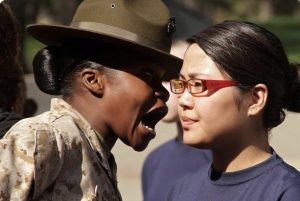
Oh, so you don’t like Carolina? Fayetteville’s not in your pretty mountains? Too hot and humid, you say? Scared of hurricanes? And you’ll miss your girlfriend?
Tough <bleeping> luck, soldier. Get in line.
And what? You’re asking how long your tour will be?
Til further <bleeping> orders — what the <bleep> did you expect? There’s a war on. Or will be in a minute.
And, oh yeah — I voted for Jesse Helms. Four times. Or was it five? You got a <bleeping> problem with that?
My certainty about coming war was hardly a prophetic insight. It too came from a military background. Many reflexes of that culture were ingrained: They (whoever “they” were, behind the dead hijackers of the September 11 planes, it wasn’t yet clear) would not get away with attacking the Pentagon, the nerve center of all the US military.
Somebody, I knew, would soon face heavy payback from the armed men and women whose headquarters and stronghold are in that building.
And chances were very high that when this war started, there would be many more innocents killed in the frenzied, fiery search for the guilty. U.S. revenge would be wreaked on some part of the world with a very broad and lethal brush.
[In the 1943 Ploesti raid, I had learned, one of the American bombers missed the refineries and crashed into a nearby women’s prison, killing over a hundred civilian inmates and staff, and injuring 200 more.]
And Chuck in 2001? How would he react to this impending combat?
The attacks had shaken him, truly, but had not undermined his basic Quaker pacifist convictions. He had just seen murder on a huge scale. But more murder, especially of civilians, was not an answer to murder. That was his conviction on September 10; it remained so on September 12th.
He also sensed he would find some small part in struggling to frame and lift up voices for an alternative. Hell, any serious Quaker (or Christian?) would.
Right?
But what alternative? And how to raise it?
Chuck didn’t know yet. But Quakers in circumstances like these are advised to wait and watch for, yes — “way to open.” Quaker experience suggests that if we are properly attentive, we will be given “leadings,” which will point the way to go.
Chuck said: I’m a Quaker in large measure because such “openings” have happened to me. In our literature such experiences are sometimes described in terms of mystical ecstasies or compared to the rush of romantic infatuation. But it doesn’t happen according to any specific schedule or formula. The tone of “way opening” could just as well be that of a gruff, gravel-voiced drill sergeant. The way that opens can be hard or dangerous, as well as fulfilling (or not).
For me, the Gospel of John 3:8 applies: “The spirit is like the wind: it blows where it wants to, and you hear the sound of it, but you don’t know where it comes from, or where it’s going.”
Reading Bonnie Parsons’ email, I knew all this well enough. I was about to learn it again.
I had the interview, went on the Quaker House payroll December 1, 2001, and moved in over New Year’s 2002.
And so, as Chuck remembered it years later, he “moved to North Carolina, successfully directed Quaker House through the Iraq/Afghan war years, and felt well-used & supported.”
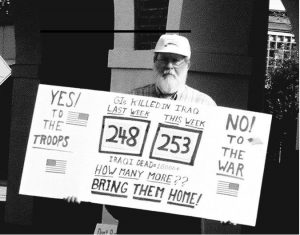
(Even politics was initially kind: The fourth “H” in his litany of reasons-for-reluctance, i.e. reactionary Senator Jesse Helms, announced his retirement shortly after Chuck arrived.)
Chuck retired himself at seventy on his own volition, passing Quaker House on to new stewards, leaving the project in good shape for its continuing mission. “For 11 years, he remembered, “I was a loyal, obedient and productive Quaker servant. I’d pledged to not cause Quaker House gadfly trouble, and kept that promise. (Well, mainly.)”
Chuck did not arrive at Quaker House with a detailed strategy. But several points were paramount:
Raise the money to keep Quaker House going.
Get ready for the coming war(s). And (maybe above all) —
Expect the Unexpected.
He coped reasonably well with the first two. And the third delivered in spades.
Despite his initial loud reluctance, Chuck was soon completely absorbed by the work there, both its growing demands and opportunities. (This rapid settling in shows — not for the first time—that his self-centered notions about life and Quaker work may not have been in tune with what deeper discernment called for and would call forth.)

So it goes. Even in the Bible. This is the spirituality of the book of Ecclesiastes. (Or maybe Ploesti?)
Ecc. 8:16-17: 16 Whenever I tried to become wise and learn what goes on in the world, I realized that you could stay awake night and day 17 and never be able to understand what God is doing. However hard you try, you will never find out. The wise may claim to know, but they don’t.
August 1 2026 is a good time to remember that.
Who am I kidding? Just about every time is.
[This post is adapted from Tell It Slant, a biography/autobiography of Chuck, by Emma Lapsansky Werner, with Chuck. More about the book here.]

nicely done
Thanks, Mark!