
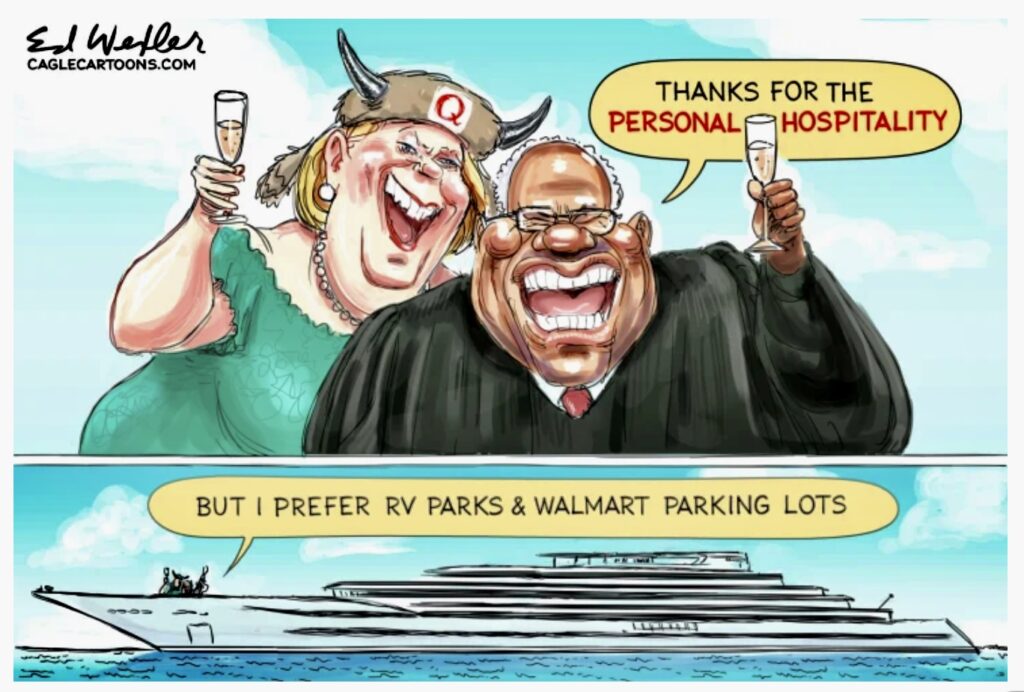
Jamelle Bouie, New York Times:
Excerpt: On Clarence Thomas & the Supreme Court’s Corrupt Impunity
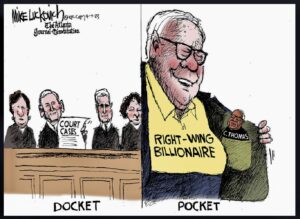
” With his close ties to a powerful, property-owning billionaire, Thomas embodies the historic role of the Supreme Court in American politics, not as a liberator or defender of the rights of political and social minorities, but as a partner to and ally of moneyed interests.
Thomas also shows us something of the real world of corruption. The Supreme Court’s ruling in McDonnell v. United States , notwithstanding corruption is much more than a cartoonish quid pro quo, where cash changes hands and the state is used for private gain.
Corruption, more often than not, looks like an ordinary relationship, even a friendship. It is perks and benefits freely given to a powerful friend. It is expensive gifts and tokens of appreciation between those friends, except that one holds office and the other wants to influence its ideological course. It is being enmeshed in networks of patronage that look innocent from the inside but suspect to those who look with clearer eyes from the outside.
The Supreme Court is not going to police itself. The only remedy to the problem of the court’s corruption — to say nothing of its power — is to subject it to the same checks and limits we associate with the other branches. The court may adjudicate disputes within the constitutional order, but it does not exist above or outside its reach.
In practice, this means the Democratic Party will have to abandon its squeamishness about challenging and shaping the Supreme Court and the federal judiciary. Whether it’s through structural change or a simple ethics code, it is up to elected officials to remind the court that it serves the republic, and not the other way around.
We have a poor record of elite accountability in American politics. But even by our pitiful standards, we seem to be living in an era of almost total impunity for people of influence. Both the powerful and their apologists treat political authority as a grant of freedom from rules, responsibilities, duties and obligations.
You see it in the case of Justice Thomas, whose defenders say he is the victim of a smear campaign. His relationship with Harlan Crow, the Wall Street Journal editorial board writes, is a “non-bombshell.”
This is not how a republic should work. Our leaders — who chose to vie for influence — should be shackled by the power they wield, not free to abuse it for their own interests and their own pleasures. And if they won’t act in the spirit of public service, then we should make them.
Recently watched on Netflix a documentary of Truman Capote. He led an remarkable life. Views of Capote were a recognition that access to the rich and powerful comes by having something to offer; in his case Capote offered wit and humor. He also realized he was viewed as one would a servant.