

ELIZABETH FRY
Adapted from a presentation by Sue Fry, an attender at Spring Friends Meeting in Snow Camp, North Carolina, on July 12, 2026
Elizabeth Gurney Fry — born in 1780 in Norfolk, England, about 100 miles NE of London — was a pioneering English social reformer and Quaker minister whose spent her life working to implement her ideas for making prisons more humane and to change ideas about what the actual goal of incarceration should be.
She was the first woman ever invited to testify to the House of Commons. Her reforms were accepted and then were first implemented at the notorious Newgate Prison in the heart of London…and later spread to many other countries.
And she did this as the mother of 11 children in just 21 years.
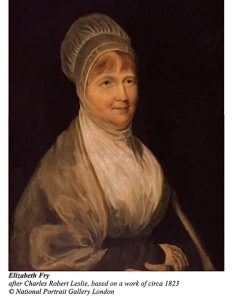
I might add that I first became aware of her in the 1990s, when I was in England and her image was on one side of the Bank of England’s five-pound note. Because we share the same last name, I asked who she was – and learned that every child in England was taught in elementary school about Elizabeth Fry – perhaps the way many American children are taught about Clara Barton or Amelia Earhart.
WHAT WAS IT THAT STARTED ELIZABETH DOING THIS WORK?
As part of a wealthy Quaker family, Elizabeth’s girlhood seems to have been a blend of vibrant privilege and deep spiritual searching.
Elizabeth’s family were “gay” Quakers – unlike the “plain” Quakers of her time, who wore drab clothing and avoided worldly amusements.
The teenage Elizabeth and her sisters wore fashionable, bright clothes—biographers always mention Elizabeth’s pair of purple boots.
Elizabeth took dancing and drawing lessons, and thoroughly enjoyed the company of local society and the interesting people her father entertained in their home —which included writers, artists and intellectuals.
Despite this lively lifestyle, young Elizabeth struggled with fits of anxiety, a self-described stubbornness —and a desire for a higher purpose.
That purpose came when Elizabeth was 17, and she heard the American traveling Quaker minister William Savery preach in Norwich .
Savery is a remarkable figure who actively preached against slavery and co-founded the Society for the Free Instruction of Orderly Blacks to provide education to free African Americans.
He mediated to defend Native American land rights during the aggressive expansion of the early United States—and played a key role advocating for Indian tribes in the 1793 Sandusky Peace Talks and the Treaty of Canandaigua in 1794.
Elizabeth heard him preach about the central importance of actively addressing human suffering, poverty, and injustice. He spoke passionately about a living, merciful God who calls individuals to transform the broken world around them.
Elizabeth’s sister, later wrote:
“The attention of dear Betsy was soon fixed. He began to preach, and her attention increased. I think she wept, and before the meeting was over she was large in tears… the effect of him was most remarkable.”
Immediately after the meeting, Elizabeth rushed home and wrote in her diary:
“A truly good man. I have felt there is a GOD.”
Almost immediately after hearing him, Elizabeth’s interests changed.
She began visiting the sick in her local community, and collecting clothes for the impoverished. She started a Sunday school right inside Earlham Hall to teach local, uneducated children how to read.
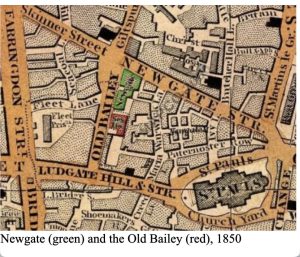
GRELLET & ELIZABETH’S FIRST VISIT TO NEWGATE PRISON
Elizabeth Fry’s historic first visit to Newgate Prison in February 1813 was prompted by a vivid, firsthand account of the horrific conditions there, as reported to her by Quaker minister and family friend named Stephen Grellet.
Grellet was French-American Quaker minister traveling in England in 1813 who visited Newgate Prison as part of his missionary work. He was horrified by what he witnessed in the female quarters, particularly the section that housed women and their children.
After visiting Newgate, he went straight to the Gurney family network for help. The Gurneys were a respected, wealthy and influential family—and he knew that Elizabeth was a young woman who was compassionate—but also practical. He thought she would care, as he did, about the women incarcerated with their children at Newgate—literally shivering to death, naked or in tatters, without sufficient bedding or even clean water.
Elizabeth immediately gathered her sisters and a group of local Quaker women. For days, the devoted themselves to sewing flannel clothing and gathering clean straw and blankets to provide immediate relief.
When Elizabeth entered Newgate Prison for the first time, the prison guards were terrified for her safety. They explicitly warned her to leave her watch outside. The instructed her not to enter the women’s yard. They cautioned that the inmates were violent, desperate, and behaved like “wild beasts”—that, dressed in rags, they would tear her clothes off.
Fry ignored them. She walked calmly—by herself—into the squalid quadrangle.
Instead of rioting, the women crowded around her but did nothing to harm her. Elizabeth distributed clothes to them. She dressed shivering babies herself. She asked the women to kneel and pray with her. Instead of the violent response the guards anticipated, the women cried.
Elizabeth was deeply shaken by the experience. And the response she had received made her determined to bring them more help and to find a way to make real, lasting change.
WHAT WAS NEWGATE PRISON LIKE IN 1813, WHEN ELIZABETH FRY BEGAN WORKING ON HER REFORMS?
In Elizabeth’s time—the early l1800s — London operated under the legal system known historically as the Bloody Code which mandated the death penalty for over 200 offenses.
• The overwhelming majority of prisoners—particularly women and children, were imprisoned for stealing things that had almost no value.
• Court records from the Old Bailey in 1820 show people being imprisoned for months—or sentenced to transportation to Australia—for stealing something as minor as:
• A single loaf of bread or a small piece of cheese or a pocket handkerchief.
• A few pieces of coal from a wharf to keep a fire going.
In Newgate prison in London, the environment was so aggressive and lawless that even the prison governors and guards were terrified to enter the female wards. They often refusing to go in unless they were heavily armed or accompanied by guards
In his book, Prison Discipline, Elizabeth’s contemporary, Sir Thomas Fowell Buxton, describes the scene she encountered on her first visit to Newgate:
“She found the female side in a situation which no language can describe – nearly three hundred women, sent there for every graduation of crime, some untried, and some under sentence of death, were crowded together in the two yards and the two cells.
Here they saw their friends and kept their multitude of children, and they had no other place for cooking, washing, eating and sleeping. They slept on the floor, at times one hundred and twenty on one ward, without so much as a mat for bedding, and many of them were nearly naked.
She saw them openly drinking spirits, and her ears were offended by the most terrible imprecations. Every thing was filthy to excess, and the smell was quite disgusting. Every one, even the Governor was reluctant to go amongst them. He persuaded her to leave her watch in the office, telling her that his presence would not prevent its being torn from her.
She saw enough to convince her that everything bad was going on. In giving me this account, she repeatedly said ‘all I tell thee is a faint picture of the reality; the filth, the closeness of the rooms, the ferocious manners and expressions of the women towards each other, and the abandoned wickedness which everything bespoke, are quite indescribable’. Two women were observed in the act of stripping a dead child, for the purpose of clothing a living one.”

This heavy iron clad oak door from the interior of Newgate prison, which was demolished in 1902. The Old Bailey courts were later built on the site. The door probably led out onto one of the inner yard. From the collection of the London Museum.
Hundreds of women—along with their children—were crammed into a handful of small rooms and a narrow yard.
No beds, mattresses, or blankets were provided. Women and their children—including newborns and infants—slept directly on the bare, damp stone floors, with nothing but what they were wearing and perhaps a bundle of straw.
Because there was almost no ventilation, clean water or sanitation, the stench was overwhelming and disease was rampant.
The prison provided only a basic ration of bread. The only way to get clothing, food or charcoal for heat was from people outside the prison. If you had no money or family that could bring these things to you, you had to purchase them from the corrupt prison guards. If you had no money to pay the guards, you went cold and starved.
Murderers awaiting execution were locked in together with women who’d been imprisoned for stealing a loaf of bread.
Drunkenness, swearing, gambling, and violent brawls were common because liquor was openly sold inside the prison by the guards.
There was absolutely nothing to do but sit in the filthy darkness. Women spent weeks and months totally idle—which led to gambling, fighting and insanity.
 A public execution at Newgate, London
Thomas Rowlandson, about 1806.
Newgate Prison was the city’s chief prison and from 1783 public executions were held there regularly on Monday mornings.
WHAT CHANGES WAS ELIZABETH FRY ABLE TO EFFECT?
Elizabeth Fry was the first woman to give official evidence to a British Parliamentary committee, providing groundbreaking testimony before the House of Commons in 1818 and later the House of Lords in 1835.
Her evidence was full of data and was instrumental in passing landmark legislation based on her recommended reforms.
The Gaols Act 1823 officially codified many of the reforms she was able to have instituted at Newgate into British law.
The corrupt system where inmates had to pay guards for any food ended. The use of heavy iron fetters on women ended.
For the first time, men and women were segregated into separate areas of the prison. Before Elizabeth Fry’s work at Newgate, female prisoners were completely at the mercy of male jailers and often housed in close proximity to male inmates—both of which resulted in open physical and sexual exploitation . Fry’s reforms required that anyone guarded women in prison must also be female.
Productive Labor was introduced. Elizabeth was allowed to bring materials into prisons, so female inmates could learn sewing, knitting and patchwork. The inmates were allowed to sell these goods and keep a portion of the earning, giving them a way to save a little money for after their release.
Prisoners themselves created a code of conduct. To foster a sense of personal dignity and community accountability, Elizabeth formed the Association for the Improvement of the Female Prisoners in Newgate and inmates were asked to directly to vote on and adopt a code of conduct regarding cleanliness, sobriety, and language,
Basic Education was offered: Fry established a prison school within Newgate, providing basic literacy, religious instruction, and needlework education for both the female prisoners and any of their children living in prison with them.

Newgate prison circa 1810. The Central Criminal Court, known as the Old Bailey (after the street in which it stands) was built where Newgate prison formerly stood.
ELIZABETH FRY REFORMED THE TRANSPORT OF BRITISH CONVICTS TO AUSTRALIA
She successfully pressured the British government to improve the safety and sanitation of the transport ships. She personally visited these ships before departure, organizing the women into small working groups and equipping them with Bibles, knives, string, and fabric scraps so they could sew quilts and maintain their dignity during the long voyage. Upon arrival in Australia, the local committees she inspired helped establish shelters and safer processing for the newly arrived women.
BEFORE FLORENCE NIGHTINGALE, ELIZABETH FRY HELPED ESTABLISH INTERNATIONALNURSING STANDARDS
The Institution of Nursing Sisters, which she founded in London in 1840, provided rigorous training for professional nurses. This model directly inspired Theodor Fliedner in Germany, who founded the Kaiserwerth Deaconess Institute. It was at Kaiserwerth that Florence Nightingale—regarded as the mother of modern nursing—received her primary training.
QUEEN VICTORIA WAS A BIG SUPPORTER
Queen Victoria supported Fry’s campaigns financially and contributed funds to help further her work. She met with Prince Albert and England’s hero of heroes, the Duke of Wellington.
Her high-profile meetings with the young Queen Victoria—along with a celebrated 1842 tour of Newgate Prison with the King of Prussia—drew a huge amount of public attention. While this royal backing greatly amplified her platform, it also drew some criticism from her detractors, who cynically accused her of using the prison reform platform for social climbing .
WILLIAM WILBERFORCE WAS HER CHAMPION
The famous English abolitionist and politician championed prison reform in Parliament, drawing directly from the evidence and successes of Fry’s organization, The British Society for Promoting the Reformation of Female Prisoners.
SHE HAD FANS AND SUPPORTERS AMONG EUROPEAN ROYALTY
In her later years, Fry travelled throughout France, Germany, the Netherlands, Belgium, Denmark, and Switzerland, promoting prison reform.
She was granted audiences with the King of Prussia and the King and Queen of Denmark. She used these meetings to boldly criticize their prison systems and advocate for reform.
Her visits to Germany deeply moved King Frederick William IV of Prussia. Following her advice, he introduced female warders to Prussian prisons and implemented structural design changes to improve conditions for prisoners.
She corresponded with Empress Maria Feodorovna of Russia, who was so inspired by Fry’s work that she began inspecting Russian lunatic asylums and prisons, adopting Fry’s concepts of cleanliness, regular food, and humane treatment.
HER IDEAS WERE ALSO INFLUENTIAL IN AMERICA
Elizabeth Fry never visited America—but her written works were widely read in the United States and her ideas permeate the documents and debates that shaped the American criminal justice system.
John Quincy Adams was well aware of her work and its success because he was serving as US Minister to Great Britain right when Elizabeth was starting revolutionary work at Newgate and transforming her “Ladies’ Committee” into a national sensation.
After his term as president, Adams was a congressman in the 1830s when Joseph John Gurney, Elizabeth’s brother, visited America on a long religious and reform tour, and he met with Adams to discuss prison conditions, criminal justice, and the abolition of slavery.
J. J. Gurney visited the White House where he presented his firsthand observations detailing the Fry program of reforms to President Martin van Buren, and preached a sermon to a crowd that included Van Buren and his entire cabinet.
We also know that Fry’s writings figured significantly during the presidency of Andrew Jackson. This was in the 1830s, when a major policy debate was about prisons being built at that time in Pennsylvania and New York.
American activists who brought Elizabeth’s blueprints for prison reform directly to state legislatures and the federal government include:
• Dorothea Dix, the famous advocate for people with mental health issues. Dix who studied Fry’s British reforms, and lobbied numerous U.S. presidents — including Abraham Lincoln—to change treatment of prisoners and people with mental illness.
• Abby Hopper Gibbons, a leading New York abolitionist and prison reformer, modeled her recommendation explicitly on Elizabeth Fry’s Newgate system as she fought for decades to have female prisoners managed by female matrons.
HOW WAS ELIZABETH FRY ABLE TO SUCCEED, GIVEN THE TIME & SOCIETY IN WHICH SHE LIVED?
Elizabeth was surrounded by people whose ideas about women were profoundly different from the rest of English society.
As a member of the Religious Society of Friends (“Quakers”) Elizabeth was taught from birth that the “Inner Light” of God existed equally in women and men. The Quaker society she was a part of not only allowed—but encouraged— women to speak, preach, run businesses and become ministers. Elizabeth officially became a Quaker minister in 1811.
Because her mother passed away when Elizabeth was only twelve, she and her sisters were also raised with an unusual amount of independence. They participated in the management of the household. Given that her father liked to entertain artists, authors and philosophers, Elizabeth would have had everyopportunity to hear socially progressive ideas, discussions and debates on a wide-range of subjects.
She would have known women who were ministers, who ran successful businesses, and were published authors.
And, importantly, as a Quaker, she was part of a closely bonded and supportive social, intellectual and financial network.
The fact that Elizabeth Gurney Fry was born into a wealthy family—and married into a wealthy family—was an enormous help in getting her reforming ideas heard and enacted.
To say that the Gurney family that Elizabeth was born into was “wealthy” doesn’t quite communicate the reality of her situation.
In 1785, when Elizabeth was five years old, her father and heruncle founded the Gurney & Co. bank in Norfolk. They laterjoined with other family members to expand into the City ofLondon—where the deposited agricultural and mercantile profits from Norfolk were loaned out to fund the industrial growth and trade of England and its colonies that stretched across the globe.
Within a few decades, Gurney’s Bank grew to be the greatest bill discounting house in the world—effectively controlling theliquidity of the British banking system.
During the financial panic of 1825—when Elizabeth was 45—when even the Bank of England was struggling to cope, the Gurney’s firm’s massive liquidity enabled them to step in and provide short-term loans to dozens of other banks which kept the entire British banking system from grinding to a halt.
The Gurney wealth and elite social standing gave Elizabeth Gurney Fry a thick layer of protection. While a working-class woman doing this would be viewed as a vagrant or a nuisance, a wealthy woman was viewed as a “philanthropist.”
Her family ties—and her wealth—gave her direct access to powerful men in Parliament, the City of London, and localgovernment. When she wanted to get into Newgate or have her ideas for reform heard by powerful men, the Gurney and Fry financial clout opened doors.
As mentioned previously, Elizabeth married into another extremely prominent and wealthy Quaker family. Her husband, Joseph Fry, acquired his wealth primarily through inheritance and his career as a London tea dealer and merchant. An interesting side-note is that it is well-documented that his mother’s financial acumen played a key role in building the family’s original fortune. Joseph was also the nephew of the famous Joseph Fry who founded the J.S. Fry & Sons chocolate company in Bristol—the company that invented the chocolate candy bar.
Joseph expanded his business into banking and in 1808, with his brother, established the W.S. Fry & Sons bank. Though the bank was highly prosperous for many years.
In 1828, when Elizabeth was 48 and seemingly at the height of her influence, her life changed dramatically.
Weakened by a series of poor business decisions and financial panics, and following two financial bail-outs by the Gurney family, W.S. Fry & Sons bank collapsed. The Frys were bankrupt.
Bankruptcy completely stripped her husband of his fortune, property and belongings—anything that could be sold to help pay off his debts and make his clients whole.
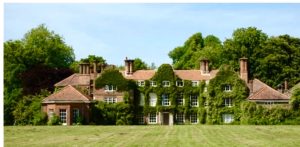
When first married, the Frys had moved to a large, grand townhouse in the financial heart of London. In 1809, the family inherited Plashet House, a mansion set on a massive country estate in East Ham, London with sweeping grounds, beautiful gardens, and plenty of space to comfortably house their 11 children and a large staff.
Forced by bankruptcy to sell Plashet House, the Fy’s moved into Upton Lane House, a much smaller home, which was lent to them by Samuel Gurney, Elizabeth’s brother.
Because honesty and fair dealing were the hallmark of Quakers and a central to their renowned success in business, the shame of bankruptcy should have ostracized the Frys. However, the Fry and Gurney families and the businesses they owned made them major financial forces in England at the time. The fact that Elizabeth’s work was well-known and admired—combined with large infusions of cash from the Gurney family—combined to make it possible for Elizabeth to continue to do her work.

The plaque is mounted on the exterior wall of the building that now occupies the site of St. Mildred’s Court, which was her home between 1800 and 1809 after marrying Joseph Fry.
HOW DID ELIZABETH FIND THE TIME AND ENERGY TO DO HER WORK?
The combined wealth and social prestige of the Gurney and Fry families certainly played a major role in Elizabeth Fry’s ability to formulate her ideas, have them heard by people with the power to implemented them, and be granted the opportunity to promulgate her proposals in many countries.
It would, however, do her a disservice to underplay the enormous difficulties she overcame to accomplish all she did.
Firstly, she was the mother of eleven children (and a total of 25 grandchildren, the first born in when she was 42—six years before the bankruptcy).
For at least 22 years of her life—the key years when she was visiting Newgate, advocating for reforms, and organizing women to do the work—Elizabeth Fry was pregnant, recovering from or in-between pregnancies. Luckily, it was not the Victorian Era—when Elizabeth was past her child-bearing years—that it became “unseemly” for a “respectable” woman to appear in public while visibly pregnant.
While the slim, high-waister Empire style of dress worn by women of that time was less cumbersome than the later Victorian fashions, a lady would have worn a stiff, whaleboned corset with a wooden or metal bush down the front center to force a straight posture and elevate the bust—as well as a bonnet and gloves. Fabrics were cotton or linen and heavy wool. The zipper hadn’t been invented: everything was buttoned or laced. There were no modern treatments to alleviate morning sickness, swollen feet, anemia, diabetes, and other common pregnancy-related conditions.
Also, in the early 1800s, pregnancy and childbirth were truly life-threatening. At that time in London, a hospital was a charitable institution designed exclusively to provide basic shelter and care for the “sick poor.” No hospital, as we know it today, existed.
Elizabeth Fry was also doing her ground-breaking work in an era when there were no cars, no trains, no London Underground.
All travel had to be done in a horse-drawn carriage or coach. And, no matter how expensive or “grand” that horse-drawn conveyance might be, its occupant was still jolting and bumping and rocking uncomfortably, making a slow progress through the filthy and stinking streets of late 18th/early 19th century London.
No trains — and also no planes. Elizabeth travelled to many countries in Europe. Her trips required her to get to the ship. Even the best accommodations would have been cramped and even the shortest voyage required sailing across the English Channel—notorious for sudden and dangerous storms—long before today’s ability to forecast weather. One landed in port, the rest of the journey had to be completed by horse-drawn conveyance.
Elizabeth was aided in her work by the following:
A full staff of housemaids, cooks, governesses, and nurses.
Until bankruptcy forced the Frys to leave Plashet House in 1829, their wealth was able to buy Elizabeth the time for her charitable work. She was able to pay to outsource the daily logistics of managing the household and raising their eleven children.

Drawing of Plashet House by Elizabeth Fry’s daughter, Katharine.
The Gurney Sisterhood. Elizabeth was one of eleven siblings herself (the famous “Gurneys of Earlham”). Her sisters—particularly Priscilla, Louisa, and Hannah— frequently stepped in to manage her household, watch her children, or take over maternal duties when Elizabeth was traveling or ill.
A Cooperative Husband and “Quaker Co-Parenting” In 18th- and 19th-century England, a husband had absolute legal and social authority over his wife; if Joseph Fry had forbidden her from going into prisons, Elizabeth’s public career would not have been possible.
Joseph Fry was a deeply committed Quaker. Because Quaker theology viewed men and women as spiritual equals, Joseph did not view Elizabeth’s work as an abandonment of her domestic duties, but as obedience to God. Despite the bankruptcy that dramatically altered the financial and social circumstances of his life and strained their marriage, Joseph supported his wife. He frequently traveled with her, helped manage her correspondence, and assisted with domestic need.
The Ladies’ Committees
Elizabeth Fry knew she could not reform the British empire alone. Her genius was not just in visiting prisons, but in organizational design.
In 1817, she founded the Association for the Improvement of the Female Prisoners in Newgate. She divided the workload among a dedicated committee of middle- and upper-class evangelical and Quaker women.
By creating a system of rotating shifts, Fry ensured that Newgate was constantly monitored and managed by her network of volunteers. This allowed her to step away to care for a newborn or recover from an illness without the prison programs collapsing
Elizabeth was smart about how she presented her work
Instead of arguing for women’s rights or challenging the patriarchy directly, she used the prevailing cultural obsession with “maternal instinct” to justify her actions. She argued that the conditions of women and children in prisons were so uniquely horrific that only a woman and a mother could understand and fix them. Fry herself was a mother to eleven children.
By framing her prison visits not as a political rebellion, but as an extension of her natural, God-given duties as a nurturing mother, she made her radical work look respectable. She wasn’t abandoning her sphere; she was expanding it to rescue the fallen.
To the male politicians and magistrates of 18th- and 19th-century England, Elizabeth Fry was transforming a expensive, dangerous social problem into an orderly, self-sustaining system of reform. They allowed her to do “unseemly” work because she was achieving the exact social stability the ruling class craved.
In short, Elizabeth Fry used the armor of Quaker tradition, the shield of her immense wealth, and the weapon of maternal respectability to walk into places no other woman dared to go.
Her reputation and the admiration for her was so strong, it allowed her to survive even the shock and shame of her husband’s bankruptcy.
THE TIDE TURNS AGAINST HER
By the late 1820s and 1830s, however, the British authorities and the public didn’t just lose interest in Fry’s methods; they actively rejected them. A combination of political anxiety, changing intellectual theories — and perhaps some misogyny—combined into cultural backlash that undermined support for Elizabeth’s reforms and belief in the importance of offering imprisoned women and their children some alternative to simply starving and rotting in prison.
There are a number of reasons why the British state and public turned against Elizabeth’s reforms.
The Fear of “Comfortable” Prisons
As Fry’s reforms spread, a powerful counter-argument emerged in the press and Parliament: prisons were becoming too nice. Critics argued that if a prison provided clean clothes,regular meals, education, and a supportive community, it ceased to be a deterrent.
In a time when working-class Britons outside of prison were starving in the factories, fields, alleys and streets, the idea that female convicts were being taught to knit and read in a warm room began to provoke intense public outrage. Critics like Sydney Smith, a prominent writer and cleric, mocked Fry’s approach, arguing that a prison should be a place of “real suffering ” and “terror”—not a “school of industry.”
This aligned with the Principle of “Less Eligibility” (most famously codified in the Poor Law Amendment Act of 1834),which dictated that the conditions of a criminal or a pauper must be strictly less eligible (less desirable) than those of the lowest-paid honest laborer.
The Intellectual Landscape
Fry’s method relied heavily on personality, religious conversion , and human interaction. Government inspectors began to view this as chaotic, inconsistent, nurturing and “maternal”— the whims of aristocratic “non-conformist” ladies. They wanted a harsh, pragmatic, disciplined approach.
The state became obsessed with the “Separate System”(inspired by Philadelphia’s Eastern State Penitentiary) and the “Silent System.” American Quakers, not to their credit, helped develop this approach.
The goal of the “Separate System” was total isolation. Prisoners were to be kept in solitary confinement or forced to work in absolute silence— including wearing hoods to prevent them from even being able to see another human being.
The government chose this system over Fry’s community-based reforms because they believed isolation forced self reflection and crushed the “criminal subculture” far more effectively than teaching reading and needlework skills that might help them better their lives.
State Control Becomes Preferable to Private Charity
When Elizabeth Fry began her work, prison management was local, corrupt, and haphazard, leaving a vacuum that private charity could help fill.
The Home Office appointed its first prison inspectors in 1835. The state wanted professional, bureaucratic control over prisons—not a network of independent committees of Quaker ladies.
As the state took over, the philosophical framework shifted from a religious battle over “sin” and “redemption” —as Elizabeth Fry saw it—to a bureaucratic battle over “crime” and“ deterrence.”
As the political climate grew more conservative in the 1830s, critics began to paint Elizabeth’s benevolence as dangerously maternalistic and sentimental. They argued that women were too soft-hearted to deal with the realities of crime and were being duped by scheming convicts who just wanted extra rations or favors.
The British government chose deterrence through systematic cruelty over rehabilitation through charity based on religious principles. The 1865 Prisons Act, formally enshrined the doctrine of “Hard Labor, Hard Fare, and a Hard Bed.”
Elizabeth’s gentle revolution where women helped women want and have the means to live a law-abiding, moral life was dismantled in favor of an industrial-scale machine designed to punish.

ELIZABETH FRY’S RESPONSE TO THE “SEPARATE SYSTEM”
Elizabeth Fry didn’t quietly fade away as the state dismantled her life’s work.
When the government began implementing the “Separate System” of total solitary confinement and mandatory hard labor, Fry used her remaining political capital to fight back.
She testified before parliamentary committees.
Elizabeth argued passionately that total isolation didn’t reform the soul; it broke the mind. She famously warned that the Separate System was “cruel” and would drive prisoners to madness and despair—a prediction that history proved correct.
She fiercely debated the government’s newly appointed prison inspectors when they criticized her ladies’ committees for being “too lenient” and offering “luxuries” like tea or clean bedding, Fry countered that Christian charity and basic human dignity were not luxuries, but the very prerequisites for reformation.
Elizabeth’s private journals from this period reveal that she felt increasingly isolated in England. She wrote about the pain of seeing prisons turn back into dark, silent machines of punishment.
She shifted her focus abroad. As noted earlier, between 1838 and 1843, despite failing health and the physical hardships of travel, Elizabeth embarked on extensive tours of France, Germany, Belgium, Holland, and Denmark that I mentioned earlier, where she was gladly received by royalty.
She helped establish prison reform societies. Elizabeth successfully argued against solitary confinement in several European states, and planted the seeds of her philosophy in minds that were more receptive than those of the British Home Office.
She diversified her efforts In her late years, she founded the Nursing Sisters, dedicated to training women to care for the sick poor (an initiative that directly inspired Florence Nightingale a generation later).
She established libraries for lone coast guards and their families who lived at remote stations across the British coast.
She increased her focus on sheltering the homeless in London during the brutal winter months.
Personal Cost and Later Years
Elizabeth Fry managed to find the time and resources because she occupied a privileged intersection of immense wealth, a supportive religious community, and a progressive marriage
Yet, Elizabeth Fry’s private journals are filled with agonizing self-doubt and intense guilt. She constantly worried that her public duties were harming her children. She wrote heartbreaking entries questioning whether she was failing as a mother by spending her days with “the fallen” instead of her own family.
Her fears were not entirely unfounded. As her children grew up, several of them expressed resentment over their mother’s frequent absences and her strict Quaker discipline. In a telling rebellion, nine of her eleven children eventually married outside the Quaker faith, directly breaking with the religious tradition that gave their mother her public platform.
She watched the British state build grim penitentiaries like Pentonville, which were designed specifically for the isolation she loathed.
Yet, Fry was never truly defeated or angry. Her journals show that her faith anchored her.
In her later years, her health deteriorated significantly. She moved to Arklow House in Ramsgate, a coastal town in Kent, seeking the sea air to soothe her ailments.
On October 12, 1845, at the age of 65, Elizabeth Fry suffered a fatal stroke in Ramsgate. Her final words, recorded by her family, were a prayer of submission to her divine calling.
As a Quaker, she eschewed a grand, aristocratic monument. She was buried in the quiet, unadorned Friends’ Burial Ground at Barking, Essex, resting alongside her fellow Quakers in a simple grave.
Conclusion: The Long Victory
The brutal practices of the Victorian prison system eventually collapsed under the weight of its own cruelty and psychological devastation.
When twentieth-century penologists began rebuilding the modern justice system, they rediscovered the reforms championed by Elizabeth Fry and began re-introducing literacy, job training and weighing the importance of human dignity.
Elizabeth Fry’s victory was not achieved by changing the laws of her own decade; it was achieved by proving to the world that her Quaker-based belief that the Light dwells within every human—including prisoners— must be honored. She widened the boundaries of what a woman could achieve. She improved the lives of people in some of the most hopeless and desperate conditions. She brought comfort and hope to the hopeless, not only in England, but in many countries around the world.

Statue of Elizabeth in the Old Bailey courthouse, built on the former site of Newgate Prison.
Elizabeth Fry was featured on the British 5-Pound Note from 2002 to 2017. She is the only woman featured on their currency other than Queen Elizabeth II.
I’m excited to see this, Chuck. I’m probably in the middle. I know of and love Elizabeth Gurney Fry! She is truly a Quaker Shero! My brother discovered a book on the shelves at our family summer place, started by our Quaker grandparents. My brother read and was delighted by the life story of Elizabeth Fry. He recommended it to me and I was delighted. I’ll have to wait until I’m there next summer to find and remember the title of the book.
I haven’t yet had time to read your newsletter on her but will do so ASAP
What an amazing woman Elizabeth Gurney Fry was!